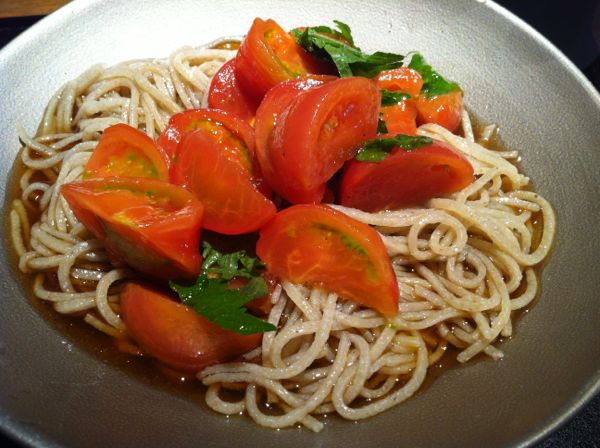
I stopped in at Soba Ryori Nicolas (pronounced ‘nikola’ in Japanese) for lunch this afternoon and was impressed! I had the ’fruit tomato’ soba and the annindofu (Chinese almond jelly) with soba honey for dessert. The ‘fruit tomato’ is popular in Japan and is greenhouse grown with a minimum of water which produces a very sweet tomato – sweeter than a ‘sweet tomato’.
Lately I have been on the lookout for restaurants with great soba cuisine – somewhere with more than just great noodles. A lot can be done with soba, which is just buckwheat. (more: soba in Kyoto)
Nicolas is a soba restaurant that I have been to a few times, but not recently. Today refreshed my memory. It is relatively new, is off the beaten path, over in Nishijin, the weaving district and is notable for the fact that it has a Michelin star. I am rather dubious about the Michelin guide and rating system and I guess I really can’t see how a soba restaurant can get a Michelin star. However, I was very happy to hear Nicholas got one because my cooking can be as good as this restaurant – so obviously, that makes me a one star chef! I account for this restaurant being awarded a Michelin star because it has a French sounding name! (Most of the Michelin three stars in Kyoto are not that good, but they have a three star history. Kichisen was apparently told that they only got two stars because they don’t have three pages of French wine on their menu. Never mind that they don’t even have a menu!
The soba noodles are handmade everyday at the restaurant, most soba restaurants don’t make their own as it is extremely difficult. The huge lacquered wooden bowl for mixing the buckwheat flour can be seen in a window behind the kitchen is offered as proof of that. Nicolas’ soba is rather thick – ‘meaty’ was the word that came to mind when I sunk my teeth in. In Kyoto, soba is often made with a lot more wheat flour than buckwheat flour, producing a very namby pamby noodle – not to my liking. Nicolas doesn’t roll like that, thankfully. Garnished with super sweet fruit tomatoes and chopped green shiso, this dish surprised me. It was completely original and was equally tasty.
The annindofu was a surprise. This is one of those dishes that to me, in principle, ought to always be great, but usually it is horrible as it is often flavored with artificial almond extract. That makes it overly perfumy and cheap tasting. Nicolas’ annindofu was the polar opposite of that. The apricot milk jelly was extremely rich and dense in flavor – surely the richest I have had anywhere. The soba honey sauce on top was dark, rich and pleasantly astringent, creating the perfect compliment to the rich, fairly sweet almond milk.
Nicolas is not cheap, I paid ¥2,000 yen for this soba noodle lunch and dessert. That is pretty expensive for a soba lunch, but I think it just might be my favorite soba lunch in Kyoto. So, it is worthy. I am planning to go again for dinner soon.
Hours*
lunch: 11:30-2:30
dinner: 5:30-8:30
closed Wednesdays and the third Tuesday of every month
*best to double check before you go
Soba Ryori Nicolas (蕎麦料理にこら)
website (Japanese language only)
tel 075-431-7567
京都市上京区智恵光院通五辻上ル五辻町69-3