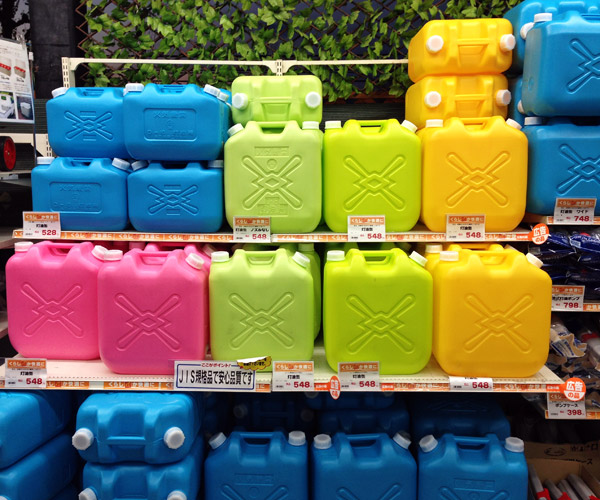
Japanese Colorful Kawaii … Kerosene Tanks

Japanese Colorful Kawaii ... Kerosene Cans

Greetings From Kyoto

Kyoto photographer Kosuke Okuda and I teamed up to do an article for the Russian travel magazine Afisha Mir (Афиша-Мир). I just got a PDF of the article — hot off the server!

In the article I introduced the long history of Aritsugu which was founded in 1560. Aritsugu is one of the most famous makers of traditional Japanese knives and they are found in good kitchens all over Japan. We focused on the special eel bone cutting ‘honegiri’ knife that is used for the traditional Kyoto summer delicacy of ‘hamo’ pike eel. The knife is over 40 cm long, weighs more that 500 gm and costs more than $1,000 USD!

I wrote it, but I can’t read it!!

Kyoto photographer Kosuke Okuda and I teamed up to do an article for the Russian travel magazine Afisha Mir (Афиша-Мир). I just got a PDF of the article — hot off the server!

In the article I introduced the long history of Aritsugu which was founded in 1560. Aritsugu is one of the most famous makers of traditional Japanese knives and they are found in good kitchens all over Japan. We focused on the special eel bone cutting ‘honegiri’ knife that is used for the traditional Kyoto summer delicacy of ‘hamo’ pike eel. The knife is over 40 cm long, weighs more that 500 gm and costs more than $1,000 USD!

I wrote it, but I can’t read it!!

Kyoto photographer Kosuke Okuda and I teamed up to do an article for the Russian travel magazine Afisha Mir (Афиша-Мир). I just got a PDF of the article — hot off the server!

In the article I introduced the long history of Aritsugu which was founded in 1560. Aritsugu is one of the most famous makers of traditional Japanese knives and they are found in good kitchens all over Japan. We focused on the special eel bone cutting ‘honegiri’ knife that is used for the traditional Kyoto summer delicacy of ‘hamo’ pike eel. The knife is over 40 cm long, weighs more that 500 gm and costs more than $1,000 USD!

I wrote it, but I can’t read it!!

Kyoto photographer Kosuke Okuda and I teamed up to do an article for the Russian travel magazine Afisha Mir (Афиша-Мир). I just got a PDF of the article — hot off the server!

In the article I introduced the long history of Aritsugu which was founded in 1560. Aritsugu is one of the most famous makers of traditional Japanese knives and they are found in good kitchens all over Japan. We focused on the special eel bone cutting ‘honegiri’ knife that is used for the traditional Kyoto summer delicacy of ‘hamo’ pike eel. The knife is over 40 cm long, weighs more that 500 gm and costs more than $1,000 USD!

I wrote it, but I can’t read it!!

Thank goodness! Kawaii colorful kerosene tanks are now available here. Japan can be really cool but also, very lame — called ‘dasai’ in Japanese. Too many gear-head salarymen making important decisions, I guess. Definitely not enough chicks in power. Now, traditional Japanese houses are COLD. Energy is expensive in Japan. Rooms are often heated (and cooled in the summer) with an electric heater/cooler mounted on the wall of each room, usually just below the ceiling. In the winter, this manages to heat the top half of the room nicely, but the bottom half, especially the floor, is cold. So, you end up paying a lot to have cold feet.

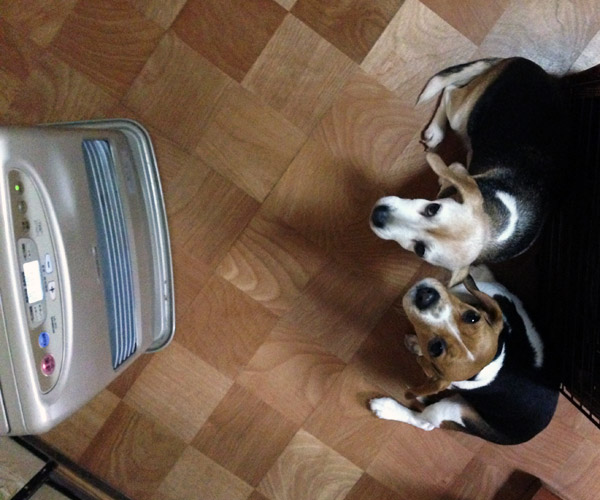
The solution is a kerosene ‘fan heater’. It is electrically powered but produces the heat by burning kerosene. And, the fan blows that precious heat out, on the floor and across the room. In front of the heater, the warmest place in the house is where my beagles can be found throughout the cold months.

Kerosene is stored in 18 liter blue plastic tanks. The kerosene truck comes through the neighborhood a few times a week and you just put your empty tanks out in front of your house if you want them to stop and fill them. They have always been the same color blue, a boring blue, since I have lived here. But today, at the home center, I was very surprised to see these kawaii colorful kerosene tanks and had to stop and take a pic. I really wanted to get some for myself, but another Kyoto value is frugality and to make due with what you already have. So, I have no colorful kerosene tanks. I really want some though! They look great!!
Japanese Colorful Kawaii ... Kerosene Cans
The beagles giving a demo of how to enjoy the kerosene stove. It is toasty!!