


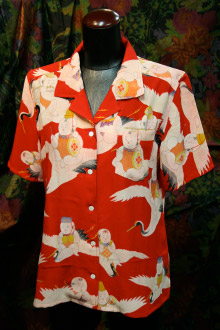
Recently I met an entrepreneur born and bred in Kyoto but has a modern, international and novel approach to Japanese traditions such as the kimono and has recently started developing a new business based on this. He is making gorgeous Hawaiian aloha shirts from vintage silk kimono.

Masaki Hitomi was the 3rd generation owner of a company specializing in used products that in recent decades focused mainly on the buying and selling of used kimono. Hitomi had an experience several years ago in which the buyer of a kimono that he sold wanted to return it, claiming that it was not an authentic vintage kimono. Hitomi decided that he wanted to make some kind of product that people would buy based on its own merits and his own originality. Hitomi wanted to continue to use high quality vintage products, preferably kimono.
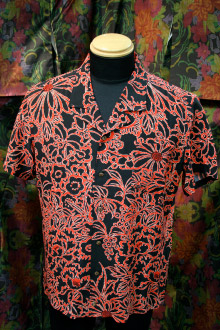
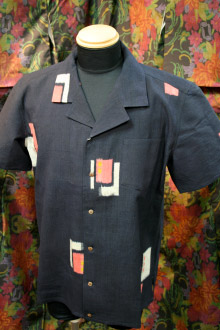
Hitomi decided on making aloha shirts from vintage kimono and named his store Kula. He uses one whole kimono to make one shirt, no patchwork. While there are several companies that make aloha shirts utilizing traditional kimono dying techniques and motifs on new fabric, Kula’s shirts seem to be the first made from actual vintage kimono.

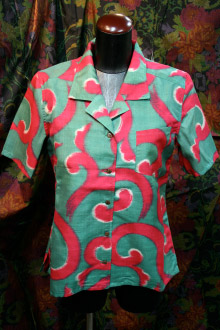
He first tried making some on his own and quickly realized the cutting and sewing kimono silk is tricky and the work of a specialist. He also realized that he needed some authentic aloha shirt patterns. He searched for a fashion designer and after meeting several people selected one to design both a men’s and lady’s design in both short sleeve and long sleeve versions.
Next came sewing kimono silk. He found a small workshop in Japan that would partner with him to construct the garments according to the designs cut by the designer.


The is all complicated but not nearly as complicated as obtaining vintage, high quality kimono. Stained, faded, worm eaten and decomposing kimono about and can be purchased as souvenirs at the monthly Kobo-san and Tenjin-san markets in Kyoto (more Kyoto market info). Making an aloha shirt that is as good as new from a vintage kimono is quite another story. The first prototype was completed in January of 2008.
Selecting High Quality Vintage Kimono
As Hitomi dealt with kimono in his previous business, he had access to large numbers of kimono to choose from.


Hitomi reports that for every 1000 kimono that he looks at, he will select 10 to 20 that will be made into Kula aloha shirts! The kimono that he selects were well cared for and protected from insects and vermin and the elements such as sunlight and all too often in old kura (storehouse), rainwater from a leaky roof. Often these kimono were never worn by their original owners.
Taisho and Showa Era Kimono
The kimono are from the Taisho and beginning of the Showa era, so from about 1920 to 1965. Kimono older than this are just in too poor quality to reuse. This era, especially the Taisho era was a time in which Japan had fully mastered Western technology but culturally, were still very ‘Japanese’, unlike today. Design of the Taisho is my personal favorite throughout Japanese history I think. It is modern, has a Western influence, but still retains what is uniquely Japanese.
Making Aloha Shirts
Cleaning: The first step is to throughly clean the vintage kimono, this is a very difficult and expensive process requiring a specialty kimono dry cleaner.
Unstitching: Once the kimono is cleaned, it is carefully taken apart, unstitched by hand, not cut. This takes 3 to 4 hours per kimono!
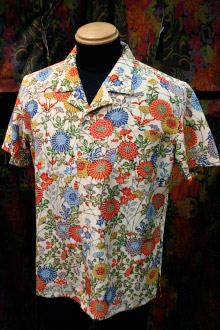
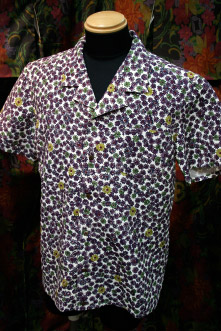
Cutting: The kimono fabric is cut into shirt parts. Kimono silk is very difficult to cut accurately. To make a kimono, no cutting is required.
Sewing: The shirt is meticulously sewn and finished with domestically produced shell, bamboo or wood buttons.
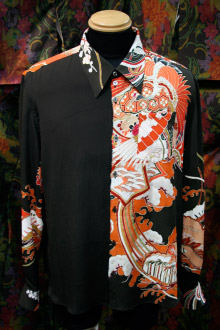

Kula Store: The next stop in the Kula showroom which opened in December 2008. It is conveniently located at the intersection of Shijo and Teramachi intersection, just north of Shijo, inside the covered shopping arcade.
Do you know the story of the Hawaiian Aloha Shirt?
The aloha shirt was developed by immigrants from Japan and China in Hawaii. The bright colors, the look and feel, was directly inspired by Japanese kimono. Japanese immigrants cut up the kimono they brought with them and sewed the fabric together patchwork style into shirts suited to the Hawaiian climate.



Beautiful shirts!
Hello extrarice, Oh, thank you for commenting on OpenKyoto, you are the very first commenter!! Thanks so much!
Yes, Kula’s shirts are really extraordinarily beautiful and well crafted. When you come to Kyoto, be sure to visit the store and see the real thing as my snap shots in this article hardly do them justice.
M
wow nice shirts will try to find the store and see what more they have ^^
These shirts are truely works of art and having lived in Hawaii for many years and worked for Liberty House Department Stores (now Macy;s), I sold Aloha Shirts by the boat load. But these are truely one of kinds that will sell in any tropical region on their pure originality. Thanks for Sharing! Best of luck to the designer, Mr. Hitomi! Absolutely wonderful!
I want to thank the blogger very much not only for this post but also for his all previous efforts. I found https://openkyoto.com/stores/kula-vintage-silk-kimono-aloha-shirts.html to be greatly interesting. Have a Excellent day!
Aloha ! These shirts remind me of the original Hawaiian shirts made in the 50’s and prior. The fabrics were made out of silk and printed in Japan as were most of the fabrics at that time ; there are many collectors who pay thousands for some of these designs. The shirts featured in your story echos of the old days. Simply lovely !
Thanks for sharing these. I’m getting married in late September. It will be an informal ceremony in a lovely Japanese garden here in Los Angeles. I’ve been looking for the perfect shirt and one of these would be just right! Is it possible to buy them online or some other way?
Help!
Are the Kimono blouses or tunics for women still being made – they look so sumptuous!