Kamo River Pigeon Feeding Lady

Greetings From Kyoto

Kyoto photographer Kosuke Okuda and I teamed up to do an article for the Russian travel magazine Afisha Mir (Афиша-Мир). I just got a PDF of the article — hot off the server!

In the article I introduced the long history of Aritsugu which was founded in 1560. Aritsugu is one of the most famous makers of traditional Japanese knives and they are found in good kitchens all over Japan. We focused on the special eel bone cutting ‘honegiri’ knife that is used for the traditional Kyoto summer delicacy of ‘hamo’ pike eel. The knife is over 40 cm long, weighs more that 500 gm and costs more than $1,000 USD!

I wrote it, but I can’t read it!!

Kyoto photographer Kosuke Okuda and I teamed up to do an article for the Russian travel magazine Afisha Mir (Афиша-Мир). I just got a PDF of the article — hot off the server!

In the article I introduced the long history of Aritsugu which was founded in 1560. Aritsugu is one of the most famous makers of traditional Japanese knives and they are found in good kitchens all over Japan. We focused on the special eel bone cutting ‘honegiri’ knife that is used for the traditional Kyoto summer delicacy of ‘hamo’ pike eel. The knife is over 40 cm long, weighs more that 500 gm and costs more than $1,000 USD!

I wrote it, but I can’t read it!!

Kyoto photographer Kosuke Okuda and I teamed up to do an article for the Russian travel magazine Afisha Mir (Афиша-Мир). I just got a PDF of the article — hot off the server!

In the article I introduced the long history of Aritsugu which was founded in 1560. Aritsugu is one of the most famous makers of traditional Japanese knives and they are found in good kitchens all over Japan. We focused on the special eel bone cutting ‘honegiri’ knife that is used for the traditional Kyoto summer delicacy of ‘hamo’ pike eel. The knife is over 40 cm long, weighs more that 500 gm and costs more than $1,000 USD!

I wrote it, but I can’t read it!!

Kyoto photographer Kosuke Okuda and I teamed up to do an article for the Russian travel magazine Afisha Mir (Афиша-Мир). I just got a PDF of the article — hot off the server!

In the article I introduced the long history of Aritsugu which was founded in 1560. Aritsugu is one of the most famous makers of traditional Japanese knives and they are found in good kitchens all over Japan. We focused on the special eel bone cutting ‘honegiri’ knife that is used for the traditional Kyoto summer delicacy of ‘hamo’ pike eel. The knife is over 40 cm long, weighs more that 500 gm and costs more than $1,000 USD!

I wrote it, but I can’t read it!!

Kyoto is a very straight-laced and staid place with precious little out of the ordinary. In one way, I suppose you could say that everything ‘Kyoto’ is way beyond ordinary — as compared to other places. But still, this place has a way of doing things that is rarely strayed from.  Then, there is the issue of style, rank and quality. Pigeons, as this postcard is about are NOT at all ‘Kyoto’. These birds are far too run of the mill, haphazardly bred and just plain old dirty for this town.

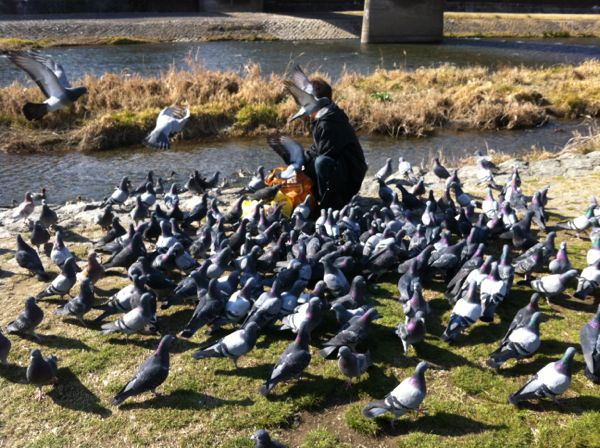
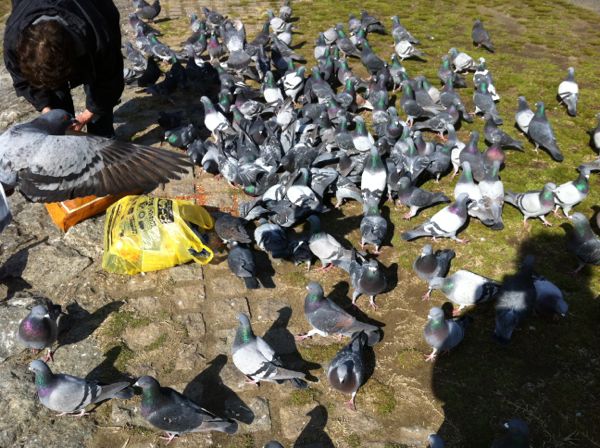
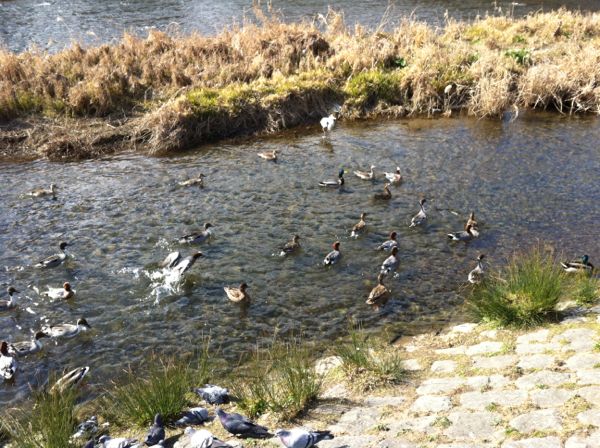
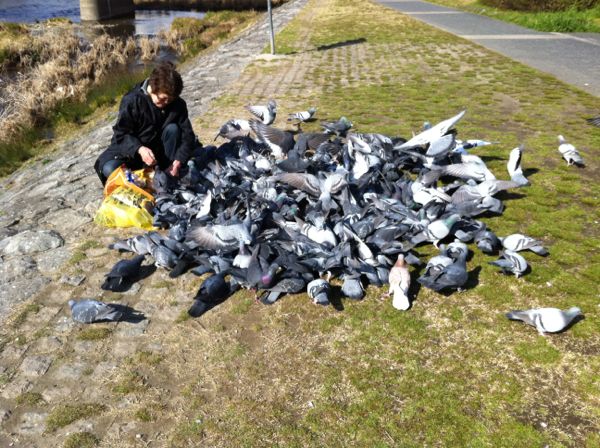
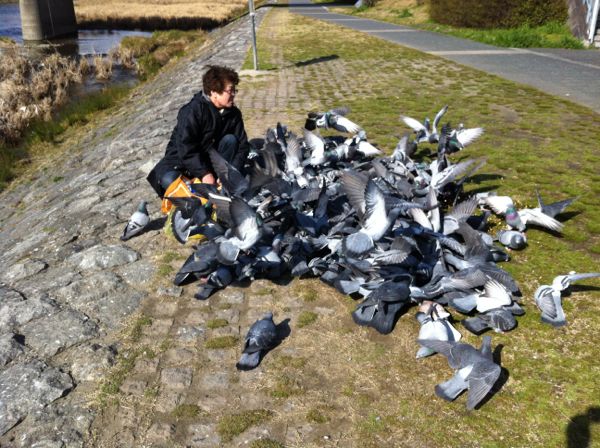
However, along the Kamo River, which bisects the city, you sometimes encounter some oddities. For example, there are some homeless people living under the bridges. They read books, keep dogs, cook food, listen to the radio and watch television. There is a local lady that feeds the pigeons (and to a lesser degree, the ducks, hawks, ravens and even herons) around the Matsubara Bridge, just downstream from Shijo Bridge.

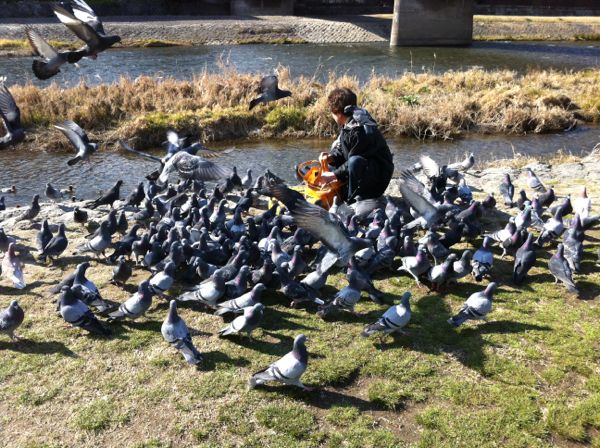
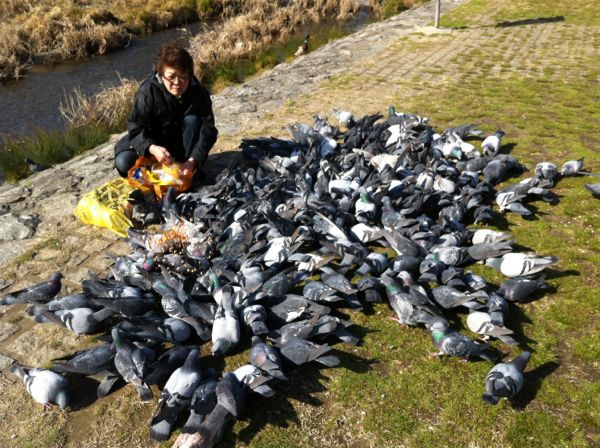
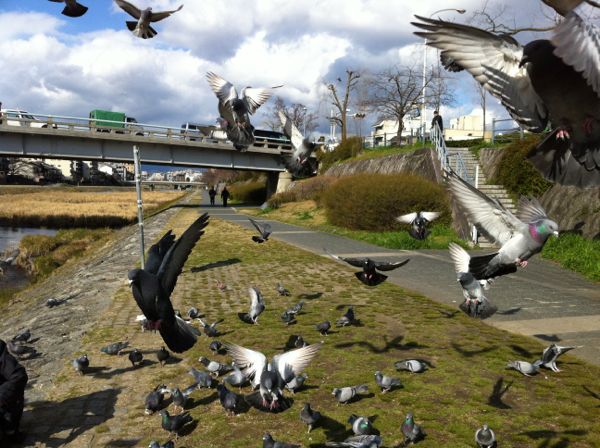
Today, I happened to walk down the stone stairs to the river all of the sudden dozens of pigeons gathered in the air above me. It was an odd moment. Then I realized, the Pigeon Lady was also descending the stair at that moment. She had several large bags filled with bread and some birdseed mixture. She had A LOT of it. And judging from how well the birds seemed to know her, I am guessing she does this pretty much everyday. She even wore what looked to be a dedicated pigeon feeding nylon coat. You know, for the inevitable pigeon pooh.

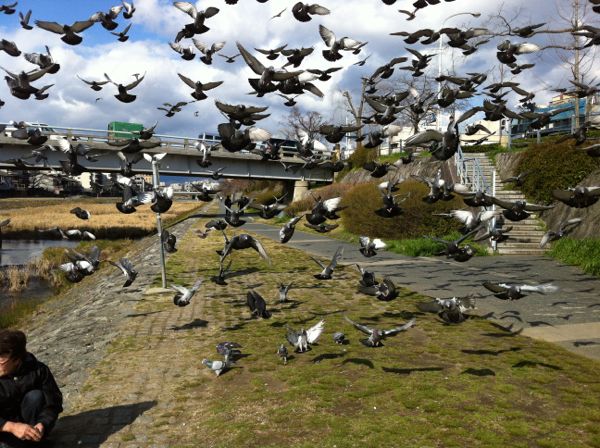
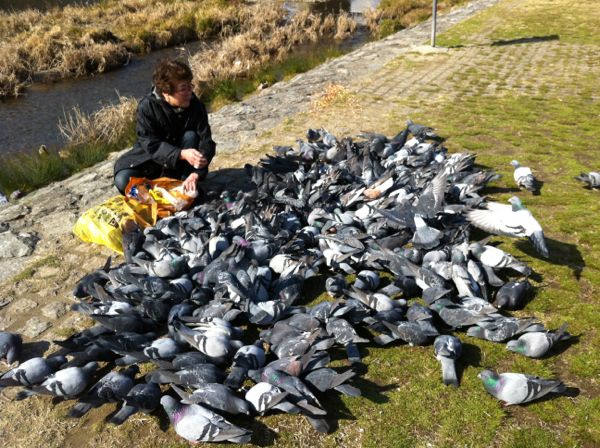
Once the Pigeon Lady started to produce bread and birdseed, the river bank was sheer pigeon pandemonium. The pictures tell the story. The best was the ‘wall of pigeon’ moments when they got spooked but quickly flew back.

I only had my iPhone with me, so I didn’t get any very good photos. I have to try this again with my SLR.
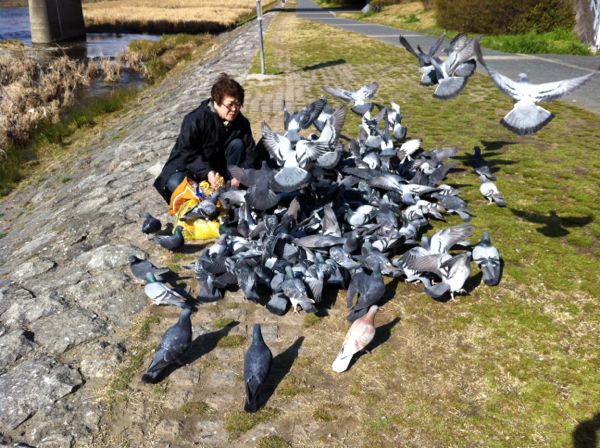
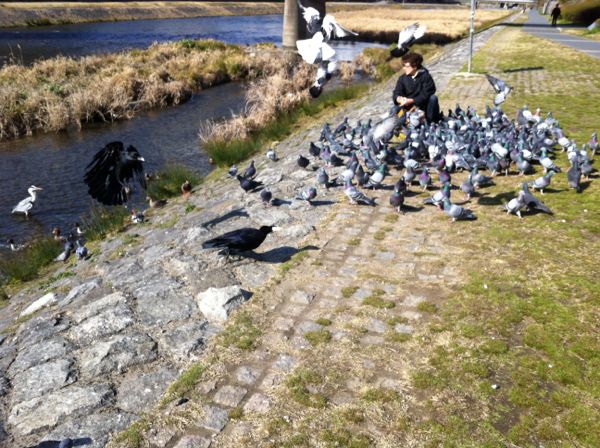
And ravens…
Ducks trying to get in on the action too.

Opening the food bags, notice the pigeon sitting on her shoulder.
The Wall of Pigeon
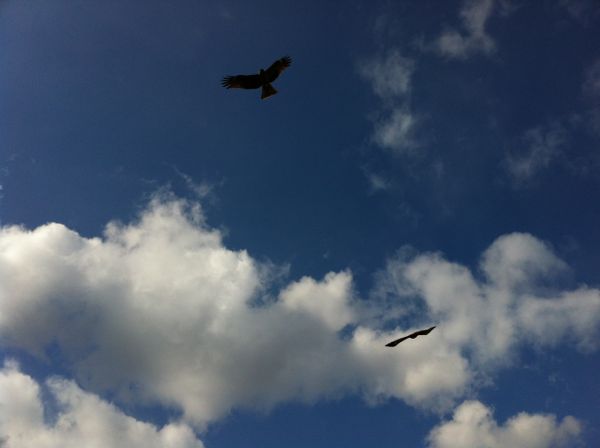
And hawks…

She gave some bread to the ducks, but not much.