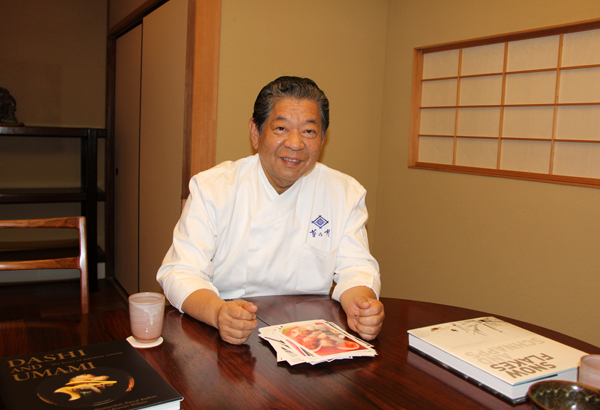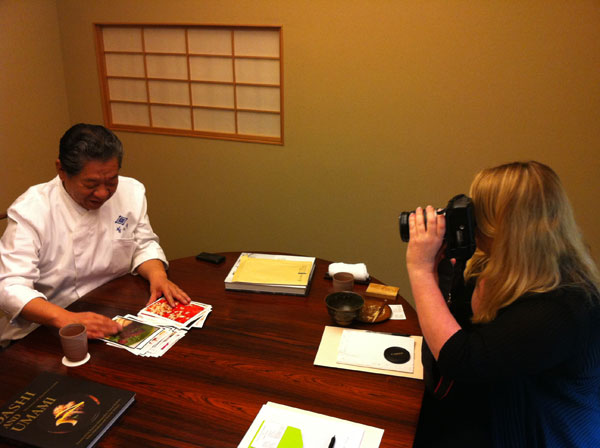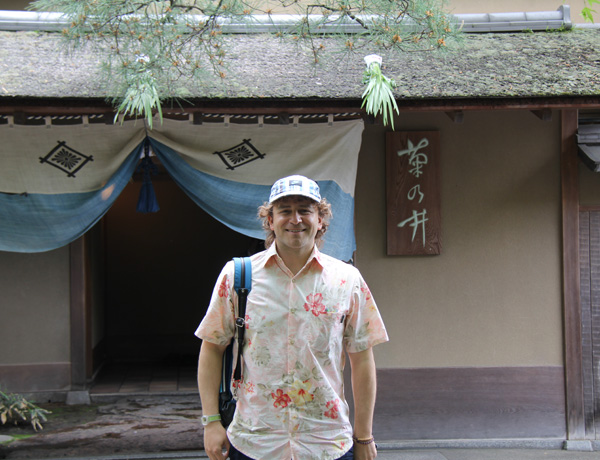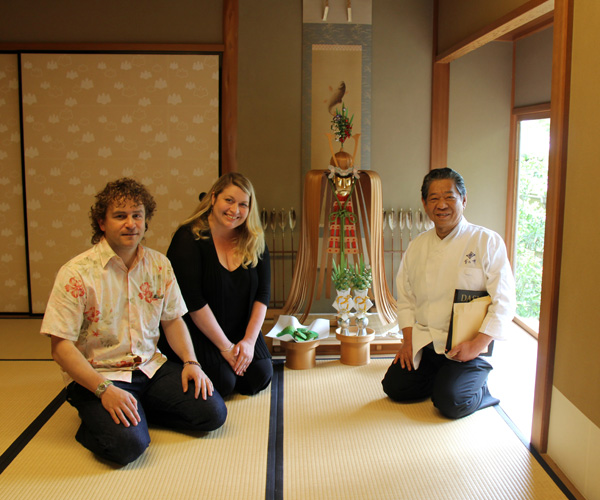
Today, fellow foodie, Kyoto fan, culinary author, Jane Lawson and I got to spend several hours interviewing Yoshihiro Murata, the owner-chef of famed Kyoto restaurant Kikunoi. Chef Murata’s three restaurants have garnered a total of 7 Michelin stars. Making him, if I am not mistaken, the most starred chef in Japan. Chef Murata is a decidedly colorful character, has a lot to say, is very knowledgeable and has a few peculiar theories. So, I think we will need to go back for further installments.
We heard about his Umami Information Center project, Japanese Culinary Academy, his new book (all Japanese food is ‘salad’), a new restaurant in London and finally his theory that Sen-no-Rikyu was Korean, not Japanese. (Personally, I highly doubt this and Murata-san volunteered that there is no concrete evidence for this.) Rikyu being Korean, played a part in Toyotomi Hideyoshi invasion of Korea in 1592 and finally, him being ordered to commit seppuku by Hideyoshi.
For me, the high point of the chat was on the subject of umami. Umami is the 5th basic taste, only discovered in 1912, by a man from Kyoto who knew that taste from Kyoto’s dashi broth. Human breast milk contains the flavor components: umami, sweetness and fat. The compounds contained, stimulate our brains causing growth and very importantly, the appetite for more. (There is ample scientific evidence to prove it.) So, our first ‘meal’ is rich in umami.
Any ideas on which three ubiquitous dishes around the world have the same flavor components (umami, sweetness and fat) as human breast milk? The hamburger sandwich, pizza and ramen!
Oh, another interesting exchange was this: I asked why beets are not popular among Japanese. Chef Murata replied that is because beets smell like earth and Japanese cuisine smells like water. Jane countered with, but Japanese eat carrots. To which Murata-san had quite a reply. To Japanese, carrots smell like makeup and lipstick. Japanese believe that Japanese that like carrots are ‘sukebe‘, literally perverse. We about fell out of our chairs. You’ve got to love this country! (The daikon radish comes from the earth, is a gift to humans from God — but it smells like water, not dirt.)
Visit Jane’s EATspeak blog