Senbei, like wagashi is one of those things people don’t really make at home in Japan. It is too much work and requires some utensils and equipment not normally found in a home kitchen.
Do you like senbei that much to go to the trouble of making it? I think that making it, and making it taste good will be a real chore. Better to just order some from Japan if you can’t get it where you live, I think.
That would be the Yatsuhashi. There are numerous companies in Kyoto that make them and they all have stores around the sightseeing places.
There are three basic kinds, raw, filled with various flavored bean pastes and baked. They are usually flavored with cinnamon.
If you are ever giving a present of sweets to someone in Kyoto, DO NOT give them yatsuhashi.Yatsuhashi is most commonly purchased by junior high school students on their school excursion to Kyoto.
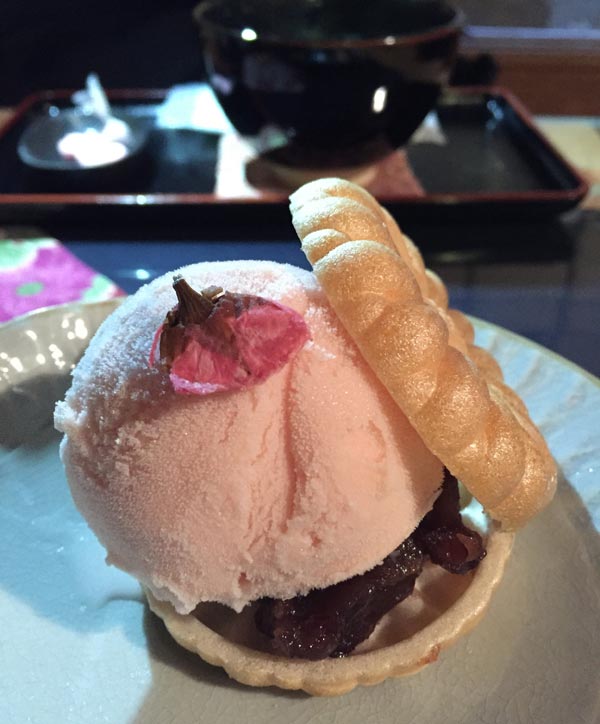
The baked ones crumbled on vanilla ice cream is great!
Hello ElisabethParis, Oh! The choice between Jodoji and Okazaki? Nice!! Both are not the most convenient places in Kyoto, I mean relatively speakings. They are both 10-15 minute by bicycle from the center of town. I lived in Okazaki for about 5 years. For shopping, especially for food, I would say that Okazaki is a *little* less convenient. Jodoji, being at the foot of the East Mountains (Higashiyama) is more historic, scenic and natural. And, there are two higher end super markets in the neighborhood. On the whole, my score would be Okazaki 7 and Jodoji 8. Not a big difference. I hope this helps.
Thank you for the info and the link! I have been to the Kawai Museum once and I loved his work very much. I don’t recall seeing the noborigama kiln though. I will have to go and check that out again.
http://www.e-yakimono.net is a site that I first discovered 5 years or so ago and is a wonderful resource. (yakimono means ceremics/pottery)
Japanese Beef (Wagyu) near the Imperial Palace (lunch or dinner):
Hafuu: located on Fuyacho Street just south of the Imperial Palace. Closed Wed. While wagyu is never very cheap, Hafuu offers high quality and good cost performance. Lunch is of course cheaper than dinner. I think that the Hafuu Katsu Sandwich is available take out and is REALLY excellent!
Thank you for contributing to the Open Kyoto Kyoto Support Forum.
I called Mr Uehara this morning about your question. Unfortunately Furosen is not currently available in the U.S.
I just called http://www.oumi-jizake.com and the owner said that they do not ship abroad. I asked if he know of any sites that ship abroad and he said that he did not.
The thing with Nama Genshu is that it needs to be refrigerated.
I am very happy to hear that my site (that is KyotoFoodie, right?) is one of your favs! Thanks much for letting me know!!
Hello Rupert, Sorry, I haven’t had time to rip that DVD yet.
About female apprentices, I hear that Kichisen has a new female apprentice — and a foreigner, no less! I understand that she heard about Kichisen via this very website and KyotoFoodie.
Browny is great. In addition to being tasty and healthy, I think that their bread and beagles are quite reasonably priced.
Hunaudieres I have been in a few times. I spotted that pumpernickel too, that is the real thing! One thing, Hunaudieres is located much closer to Shimogamo Shrine than Kamigamo Shrine.
Chicken Sukiyaki is a Kyoto original and very delicious. When you are in Japan, be sure to check out shops that sell poultry which is mainly chicken in Japan. The variety of cuts of chicken is a whole lot more than you might imagine. I guess that chicken is prepared in about 30 different cuts in Japan.
One of the fun things about chicken sukiyaki is that you can often get a half a dozen or so different parts of the chicken in your sukiyaki. When I do this dish at home, I try to get 10 or more cuts of chicken.
If you are in Kyoto and like sukiyaki, consider giving chicken sukiyaki (tori-suki) a try.
Here are two famous Kyoto chicken restaurants, both with a long history.
Hachikian 八起庵
Hachikian is a restaurant that I have been to many times and it very, very good. The chicken and eggs are raised to their specifications — very fresh and high quality. Hachikian is probably most known for their chicken kaiseki, which is very good, but if you are only in town for a short time, I would suggest that you have real kaiseki (not chicken) and have chicken suki or chicken nabe to see how Kyoto people usually eat chicken.
price: 6,800 yen (per person, reservation required)
location: Marutamachi Kawabata intersection (right around the corner from Sumibi Torito)
I usually go here for lunch and have only had dinner here once. The price was 6,000 yen per person. The food was good, the atmosphere really good as it is in an old Kyoto-style building. The service was OK and the cost performance was also just OK. If you aren’t on a tight budget and want to have tori suki in an old style Kyoto setting, Toriiwaro is a good bet.
Iroha (いろは) in Ponto-cho, on the south end near Shijo Street is my favorite place for sukiyaki. They use Omi Beef (from neighboring Shiga Prefecture) and do their sukiyaki Kansai-style which is fairly sweet. Kanto-style is salty. (Kansai is Kyoto, Osaka, Nara, Kobe and Kanto is modern day Tokyo) Iroha has two restaurants within a one minute walk of one another, I go to the one farther in Ponto-cho from Shijo. I think that one is the ‘North’ restaurant. The interior is great. It is very traditional Japanese architecture with minimalist hand colored paper screens, it always looks to me like oil pastel. I understand that the owner is a professor of art. Be sure to check out the male and female icons on the restroom doors.
The sake selection is horrible (which is usual for nice restaurants and ryokan) so I always just stick with beer.
*5,000 yen for sukiyaki in Kyoto is about average. You can find cheaper places but it is probably not ‘wagyu’ (Japanese beef)
tel: 075-221-0403
Closed Thurs
Mishima-tei
Mishima-tei is crap. (While the over-priced beef is fine quality, you can get similar beef in Kyoto at countless restaurants.) Mishima-tei’s reputation has gone to it’s head in a very large way. (This is common with about half the famous old restaurants and shops in Kyoto, that is why we started this site.)
The worst ‘good’ meal that I have ever had in my life was at Mishima-tei. It is the pinnacle of the stingy and arrogant service the Kyoto is known for in other regions of Japan. This was when I was in graduate school here, my girlfriend and I wanted to have a nice New Year’s dinner at Mishima-tei. She called and asked asked about the prices and then asked if they had a table charge. They said no. At dinner we asked for more tare (sukiyaki shoyu sauce) — and they said that they charge extra for it!! Can you believe that? Charging extra for soy sauce at a Japanese restaurant!?! Unbelievable. Then we wanted more eggs which they charge for. OK, maybe. How much? I think it was 700 yen for a single egg! That is a complete ripe off! 200 or 300 yen is kind of expensive, but if they are good eggs at an exclusive restaurant, fine. The worst was yet to come. The bill. The bill had an additional 7000 yen on it and we were like, ah, what is this? The wait staff says, oh, that is the service charge. We protested, my girlfriend said she called and asked if they have a table charge. They reply, that is a service charge. If we are in a court of law, fine, we lose. But come on, we call and are trying to find out how much it is going to cost. The point is not semantics! Sh’eesh! The service was less than friendly as well. This all made Mishima-tei a horrible experience for me. With all that unpleasantness, their famous sukiyaki doesn’t even taste good.
I have eaten at Mishima-tei since and sometimes bought their beef for Japanese New Year’s sukiyaki. The service was cold and the beef overpriced.
I have been to Iroha countless times and never experienced anything unpleasant. I doubt that Meishima-tei really tastes any better than Iroha. Also, inside, Mishima-tei is pretty rundown. So, I recommend Iroha for dinner and recommend Mishima-tei for the Hall of Shame.
Teppanyaki: Sou
I very rarely eat teppanyaki. Teppanyaki isn’t real Japanese food in my book and I hate getting covered in cooking oil while I wait for them to cook my dinner.
I did discover this teppanyaki restaurant in Gion called, Sou, that is very, very nice. Excellent food and excellent service. My friend has been teaching the manager English for a year now, so foreign visitors should have an easy time communicating. Though in Gion, the cost performance is quite good too.
A number of temples and several shrines and the castle in Kyoto have springtime ‘light-ups’ in which people go to see the cherry blossoms at night and the trees are lit up, usually from below. The sakura flowers are very delicate and light pink in color, so they are not that prominent against a light blue sky or white clouds. Being lit up at night helps one focus on and accentuates and dramatizes the beauty of the sakura. These light-ups are extremely popular in Kyoto.
Kodai-ji Temple (高大寺)
Kodai-ji Temple is a Zen temple located in the scenic Higashiyama/Gion neighborhood. It is an historic temple and was the residence of ‘Nene’, the ex-wife/widow of warlord Toyotomi Hideyoshi. Kodai-ji has a spring sakura light-up and an autumn momiji (maple) light-up every year. In addition to the temple buildings there are three wonderful tea houses in the garden that are important cultural properties. One of the rock gardens has a funky light show designed by a different artist every year. Be sure to walk up the hill in the back of the garden to see the two tea houses on the hilltop and the bamboo grove which is also lit up.
Nijo-jo Castle (二条城)
Nijo-jo Castle is a blockbuster of a sakura light up and is conveniently located on the Tozai subway line at the intersection of Horikawa and Nijo Streets. While the castle interior is not open in the evening (it is during the day) the grounds, with a large number of sakura trees are dramatically light up. This is the only place in Kyoto where you can see sakura blossoms on a large scale amid castle moats and ramparts.
Timing: Traditionally, sakura bloomed at around the beginning of April, but now with a warmer climate this generally happens a week or so earlier now. So, generally, it is late March now. However, the winter and early spring weather of the year determine when they will bloom, and there are numerous varieties of sakura, some blooming early, some late. For example the sakura at Gosho (The Imperial Palace), bloom quite early.
Hanami (Flower Viewing): Many people picnic and barbecue under the sakura trees, often at night. This can be nice but generally it is loud, extremely crowded, there are a lot of obnoxiously drunk old men and there is often stinking garbage piling up. Maruyama-koen (Maruyama Park), at the east end of Shijo-dori (Shijo Street) is a popular destination for this kind of hanami. Light ups on temple grounds, anywhere that an admission fee is required, will be free of picnickers.
I stopped in at Osaki Shoten 大崎商店 in Fushimi yesterday and was very impressed with their selection. The owner is friendly and really into excellent sake. I doubt that they speak English though. They don’t even have a website.
The building is a large machiya and the store is packed with sake and shochu. If you are in the neighborhood, it is certainly worth a peek. Though this store is in Fushimi, they stock fine sake from all over Japan.
I heard from a mutual friend last night that Tanigawa had a female apprentice at Kichisen a few years ago.
He gives out this DVD to people with several TV programs about him. One is about his dojo. The TV program shows him hitting students quite a number of times. There aren’t a lot of restaurants that ‘teach’ like that anymore, but he still does. He will tell you that is the way that he learned and it is indeed the traditional way of learning a craft in Japan.
I will try to get the TV program up on YouTube in the near future. If anyone is considering requesting to apprentice at Kichisen, you would probably want to watch the video first.